LAGASA’s Stakeholders, Donors and Programme Participants and its Related Scope of Work
LAGASA has identified several key sectors, and thus stakeholders, who will benefit substantially from its Programme offerings.
These include, among others:
- private legal and corporate institutions – irrespective of whether they are performing private or public functions;
- governance and civil-service institutions and departments;
- integrity and accountability (I&A) , fourth-branch bodies (such as the Public Protector, the other Chapter-9 constitutional institutions, as well as various regulatory bodies, or ombuds in niche sectors;
- educational and research institutions and institutes;
- non-governmental organisations (NGOs) and other civil-society bodies; as well as,
- individuals wanting to enhance their practical expertise and/or substantive know-how in a particular discipline or field/s.
To spearhead this multi-stakeholder capacity-building effort for these key sectors, LAGASA steps in – and steps up – with bespoke Programmes for their individual participants, as supplements (and/or complements) to any existing offerings.
LAGASA’s multi-stakeholder audience can be depicted diagrammatically as follows –
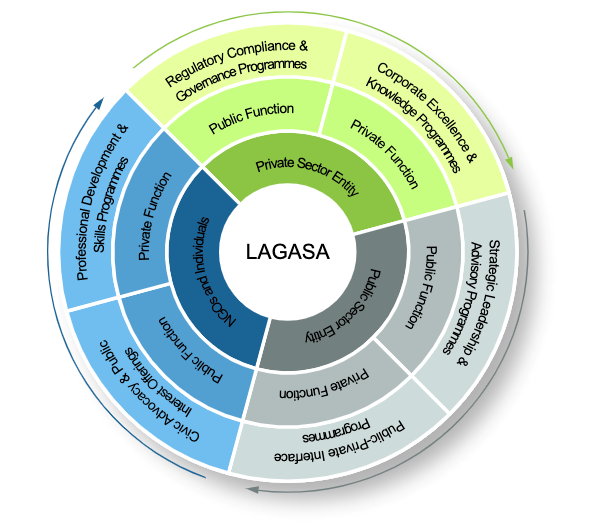
Stakeholders in this array of sectors – whether performing public or private functions, and irrespective of their organisational nature – are experiencing pressures that LAGASA’s fresh approach is perfectly placed to address.
These pressures include the need to devote significant additional, often wasted, resources for extended periods of professional development, or technical-expertise building, especially for new graduate recruits who are often increasingly lacking in the competencies and motivation required to navigate real-world practice successfully and sustainably.
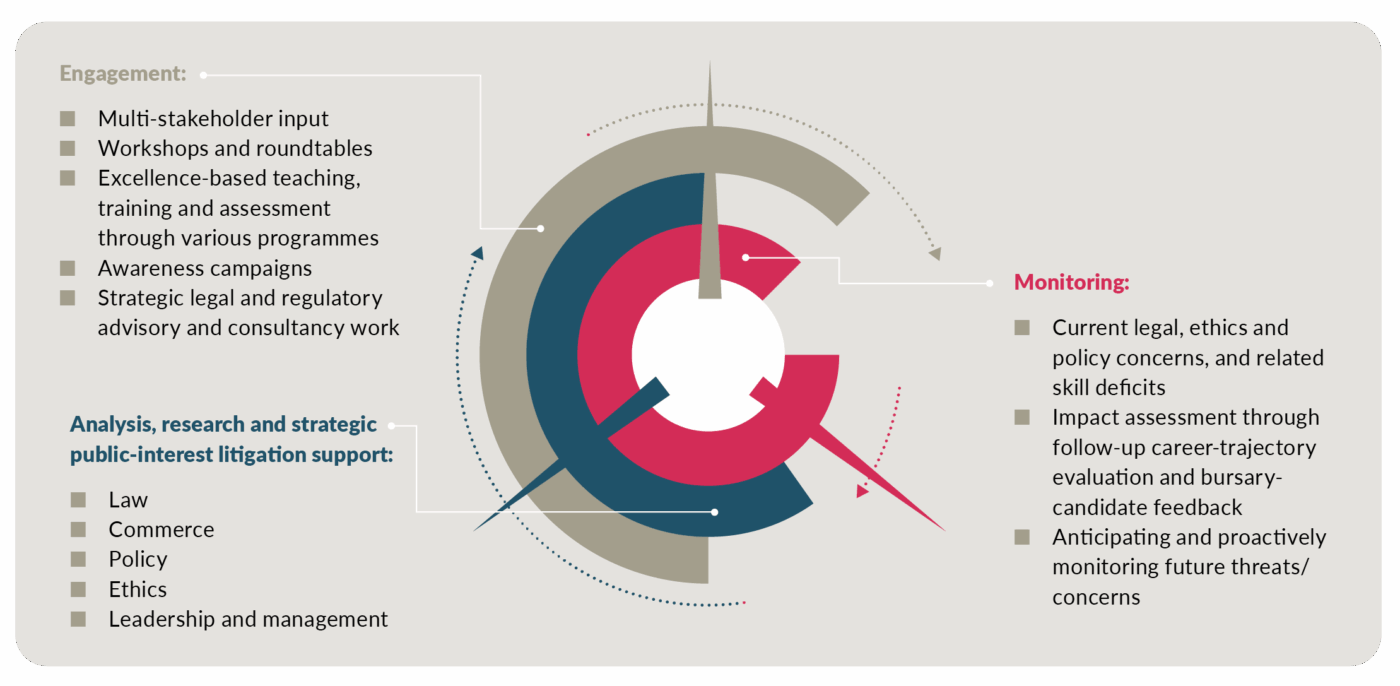
LAGASA’s scope of work will be tailored to its specific stakeholder’s / donor’s needs and objectives and can be depicted thus:
LAGASA’s Methodology and Programme Implementation Strategy
LAGASA’s integrated methodology offers its multitude of stakeholders a strategic opportunity to accelerate the likes of the campus-to-practice developmental process, while optimising (not duplicating) any existing training investments.
Beyond individual-skills enhancement, participation in LAGASA Programmes thus strengthens the institutional capacity of its stakeholder entities and gives effect to donor(-stakeholder) fundamental objectives.
For example, public-sector institutions (performing public functions), such as:
- the National Prosecuting Authority (NPA),
- the Department of Justice and Constitutional Development (DoJCD),
- the South African Police Service (SAPS),
- the Public Service Commission (PSC),
- the Chapter-9 Constitutional institutions tasked with ‘strengthening constitutional democracy’, and/or other ‘I&A fourth branch bodies’, such as the Judicial Service Commission as well as,
- Specialist ombuds bodies within niche regulatory (and/or other) sectors,
may already have good training academies in place; however, these stakeholders will still find in LAGASA a cost-effective, impactful, strategic and synergistic solution.
Examples of Private-sector LAGASA Programmes include:
- A soon-to-be implemented one that has been carefully curated for the 2026 candidate legal practitioners (CLPs) of a leading South African law firm better to transition them from lecture-hall life to real-life practice of the law.
- Additionally, an interactive and multidisciplinary Programme offering has been created to serve all corporate clients seeking to empower, in particular, their ‘first-line-of-defence counsel’ in militating against corrupt practices as a proactive and protective measure, given the recent coming into force of section 34A of the Prevention and Combating of Corrupt Activities Act.
Whether public, private, or otherwise, these sectors’ existing professional development and training offerings will be supported by LAGASA as a bridging mechanism that builds on their existing offerings, adding a cross-disciplinary, expert ‘gloss’ to boost their respective institutional resilience from grassroots-level up, thereby enhancing:
- a culture of excellence and ethics within institutions, as well as
- individual LAGASA participants’ sense of personal and professional pride in their chosen vocations.
LAGASA’s implementation strategy is based not only on Kohn’s track-record of effective pedagogical methodologies and inspired teaching, but also her openness to embracing innovation. To this end, the LAGASA implementation strategy is a:
- uniquely crafted,
- phased, and
- thematically scaffolded and synthesised approach to teaching and professional development.
This approach begins with:
- targeted ‘project-1’ interventions that address the immediate needs and goals of stakeholders, donors and/or participants, with a focus on benchmarking the necessary basic, critical, analytical, interpersonal and other core skills for ‘the job’.
- It then expands on this first modularised project programme component with ‘project-2’, deep-dive modules that further explore the practical and theoretical implications of the ‘basics’ benchmarked in project 1.
In this way, LAGASA builds and sustains individual capacity and a constant openness to learning and self-reflection, without the encumbrance of participant ‘reading and/or examination overwhelm’.

LAGASA’s approach thus blends flexibility with a clearly structured, modularised, pedagogical approach that guarantees stakeholder institutions and donors optimal value from respective participant participation and enables these institutions to contribute to the broader goal of strengthening institutional resilience and professionalism across the board – LAGASA’s fundamental public-benefit focus.
Among others, this ‘focus’, combined with LAGASA’s unique approach to Programme design and implementation is what sets LAGASA apart from all existing tertiary- and/or vocational, continued professional development, and graduate-readiness offerings.
LAGASA’s unique methodology is built on three core pillars.
- First, the LAGASA approach emphasises active knowledge integration by revealing intersections between different legal, commercial, governance and other, disciplines.
- Rather than treating fields of expertise as silos, LAGASA’s project offerings illuminate how seemingly separate areas of law and policy, (within and across sectors) interact, converge and reshape one another in the real world.
- For example, one of LAGASA’s pioneering project modules addresses how A.I.-driven workflows have reshaped the cognitive and interpersonal capabilities of emerging legal professionals.
- Recognising that today’s lawyers, prosecutors and so on, increasingly rely on A.I. for routine analysis, LAGASA’s teaching and training method return to, and actively rebuild, the requisite professional judgement, creative problem-solving and ethical reasoning that A.I. tools cannot replace, while not shying away from their effective use.
- Through carefully designed case studies and practical exercises, participants will thus sharpen their own critical reasoning skills and ability to think independently, with discernment, while building an awareness of, for example: what are the right questions to ask A.I and when? When and why cross-checking of A.I outputs is required and how? etc.
- Second, LAGASA offers continued mentorship Programmes to enable its participants to broaden their practical perspectives and build relationships across traditional institutional boundaries. It will also ensure that theoretical learning is consistently grounded in practical reality….and that the learning never stops.
- Third, where required by stakeholders, LAGASA Programmes will use its carefully designed benchmarking evaluation and follow-up assessment framework.
- This framework will help measure the development of participants’ technical competencies – for example, in strategic thinking, problem and solution identification, ethical decision-making, and leadership acumen.
- Further, this comprehensive assessment approach will help both participants and their stakeholder organisations measure progress in a supportive way, and while identifying areas for growth.
- As the saying goes, if you cannot measure it, you cannot improve it. LAGASA is where the ‘learning rubber really hits the road’ in terms of identifying and measuring its actual impact at grassroots level.
LAGASA’s development strategy thus addresses both immediate competency and long-term, professional growth needs.
LAGASA’s participants will grapple with real-world case studies that require an ability to think holistically, practically, analytically and incisively. LAGASA will achieve this objective for its participants while also developing their foundational, analytical and interpersonal skills essential to real-world practice, management and leadership. This learning experience will not simply be a ‘means to an end’ but a worthwhile ‘end’ in and of itself.
By recognising the need to marry the likes of:
- theory and practice,
- hard and soft skills, and
- technological advancements and the need for a well-honed human, professional instinct,
and do so in a way that synthesise disciplines, LAGASA is ‘the bridge’ to a culture of institutional resilience, excellence and integrity.
Further, LAGASA’s powerful combo-learning-experience that entails both:
- a kind of ‘back-to-basics bootcamp for brilliance’ approach to teaching and professional development; with
- an innovative methodology for Programme delivery that breaks down silos within (and across) applicable legal and other Programme disciplines,
enables LAGASA to create a dynamic learning environment tailored to each stakeholder organisation’s and participant’s, needs, building on existing individual and institutional strengths and growing participant’s skills, motivation and commitment to professionalism.
LAGASAs Programme participants will thus ‘graduate’ from the Academy superbly equipped to transition with ease, and renewed inspiration, into the real world of practice; and/or into new fields, or tiers within their chosen institutional homes.
LAGASA is the REAL DEAL.!